
—— Overview
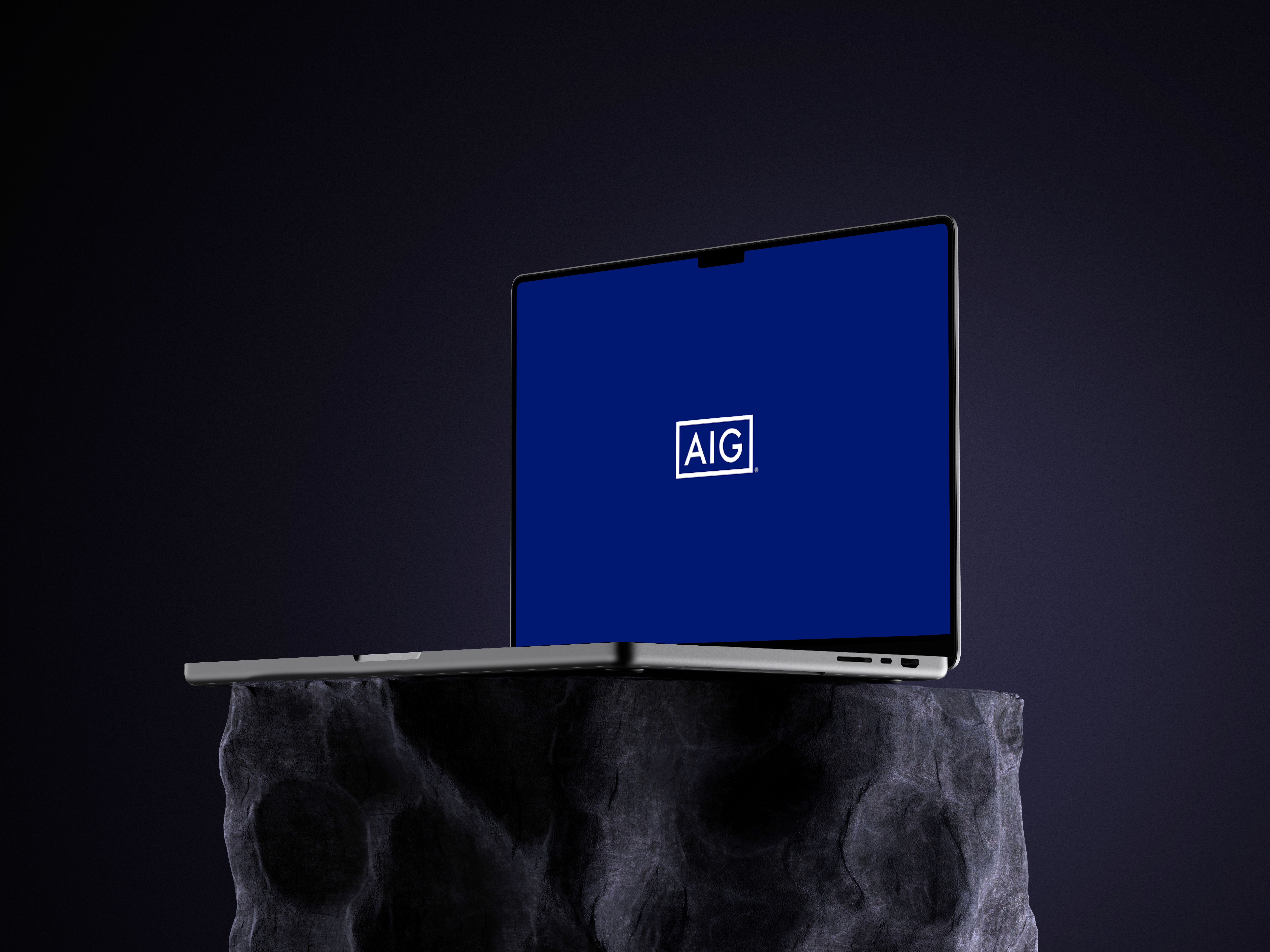
AIG needed to bring malware detection and URL verification capabilities into their global Cyber Portal, a complex multi-audience tool used by underwriters and customers across internal and external portals. Working within Agile, I joined a team of four and owned the end-to-end UX for two major new features, delivering accessibility-approved wireframes on time and coordinating directly with development throughout.
Client
AIG Insurance
Date
Role
UX Designer,
Service
UX Design, UI Design, Accessibility, Enterprise Product Design
Contribution
Responsible for stakeholder meetings, requirements gathering, domain research, user flow design, wireframing, accessibility compliance, malware alert UX, URL verification feature design, watchlist functionality, and engineering handoff.
—— Brief
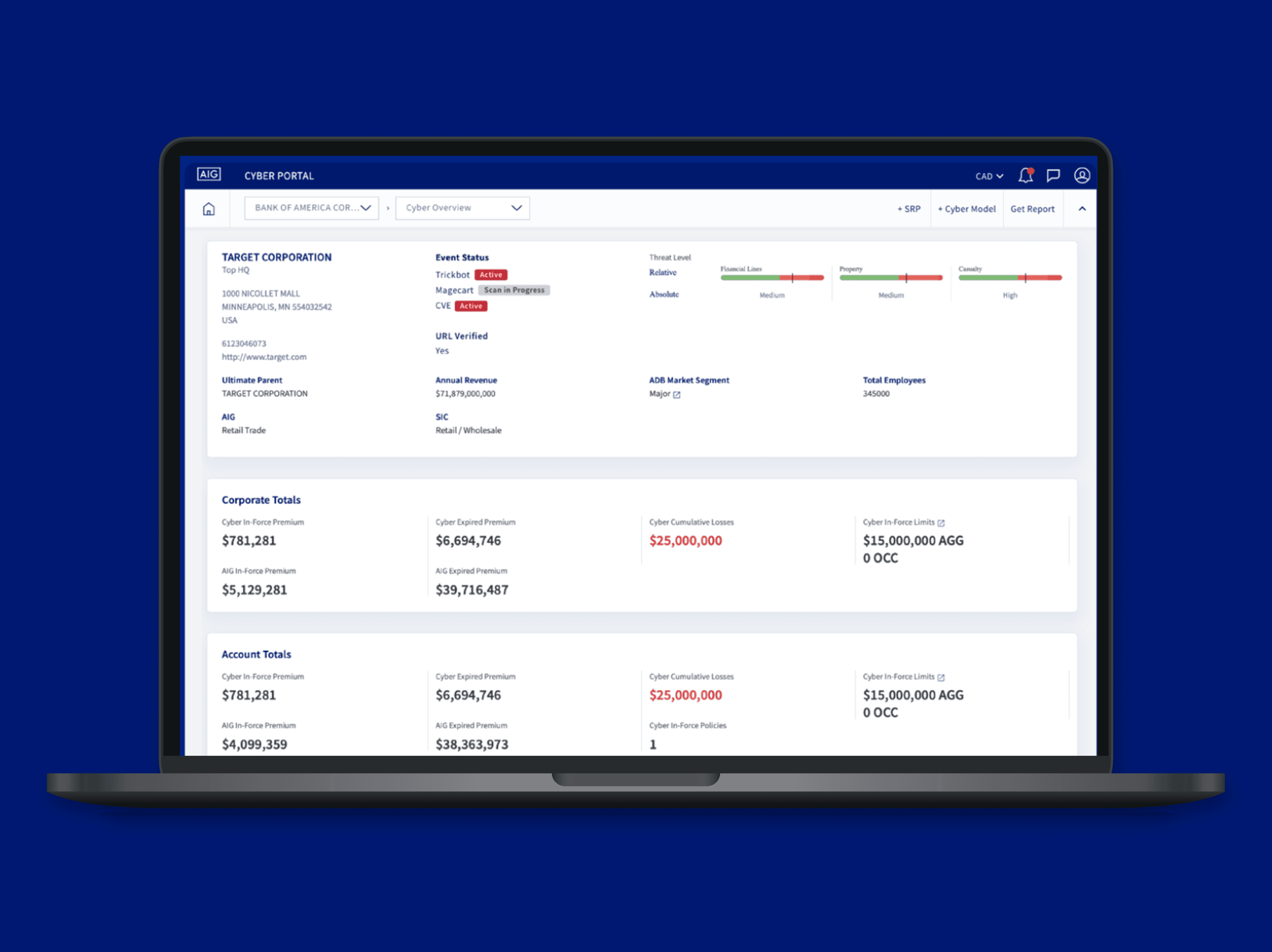
AIG's Cyber Portal needed to do more: detect malware, verify URLs, and alert underwriters in real time, without adding friction to a workflow where speed and accuracy are everything.
A feature design and delivery engagement within an existing enterprise portal, working Agile alongside a product owner and two business analysts to define, design, and ship two mission-critical new capabilities for underwriters managing cyber claims globally.
4
Portal user types supported
2
Major features designed and shipped
3
Malware alert touchpoints designed
Note: Sensitive data blurred for confidentiality.
—— CHALLENGE
The Cyber Portal was already a complex, data-dense tool serving four distinct user types across internal and external portals. Adding URL verification and malware detection wasn't just a feature request. It required understanding the existing information architecture deeply enough to integrate new capabilities without disrupting established workflows. At the same time, AIG released new branding guidelines mid-project, requiring a full accessibility audit of every existing color system and text format across the tool. The challenge was doing both simultaneously without slowing down delivery.
—— solution
The core principle driving every design decision: don't interrupt the underwriter's workflow unless it truly matters. Every feature was designed to surface the right information at the right moment, in the right level of detail, without adding unnecessary clicks or cognitive load.
URL verification and malware detection
Designed a multi-step modal flow allowing underwriters to verify a URL, add Bitsight security data, initiate a scan request, and receive a recommendation, all without leaving their current screen. The process needed to be sequential enough to ensure accuracy and fast enough to not disrupt the workflow.
Three-layer malware alert system
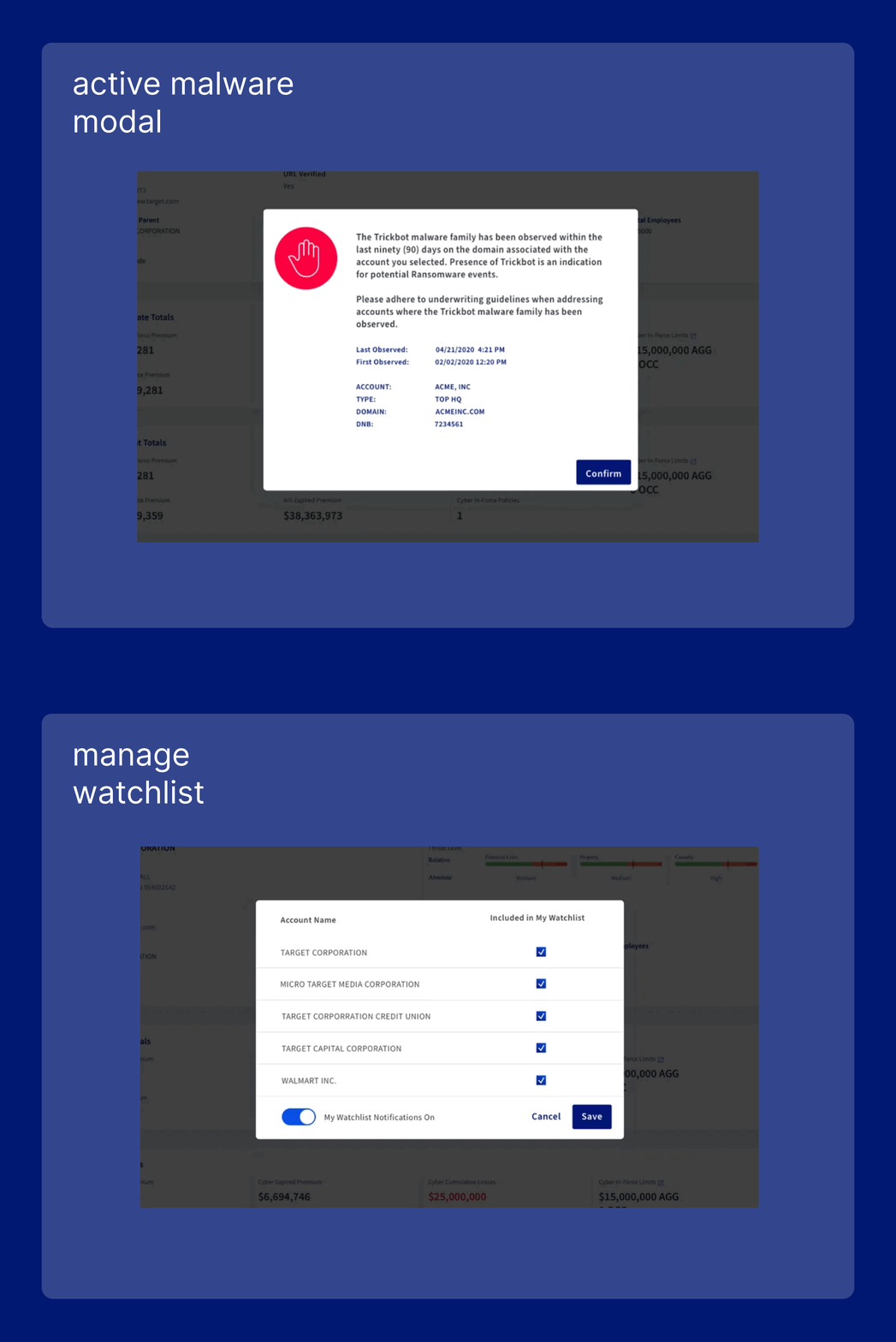
Discovered through research that underwriters needed to be alerted to malware events in three distinct scenarios: when first visiting an account, on the Cyber Overview dashboard if already working elsewhere, and globally via a notification panel for events detected while on any other page. Designed all three alert states to feel consistent, unmissable, and non-disruptive.
Watchlist and CVE management
Designed the ability for underwriters to add accounts to a personal watchlist with email notifications for updates, manage that watchlist from a single modal, and view active CVE remediations with expanded detail on hover, surfacing critical security intelligence that previously required navigating away from the portal entirely.
—— 4 key design decisions
—— PROCESS
WEEKS 1–2
Discovery and domain immersion
Attended ongoing business meetings, studied the existing information architecture, and immersed myself in the world of cyber claims and underwriting until I could speak the language of the product and its users. Asked relentlessly: where does the current process break? What does the underwriter actually need at each step?
WEEKS 2–3
Define and research
Worked with the product owner and business analysts to define requirements for URL Verification and Malware Detection. Researched existing solutions in the market. Mapped user flows to understand where new features could integrate most efficiently.
WEEKS 3–5
Ideation and wireframing
Sketched early flows and iterated on layout and interaction patterns. Explored multiple approaches to malware alerting before landing on the three-touchpoint model. Designed the URL verification multi-step modal after determining a single-screen approach created too much cognitive load.
WEEKS 5–8
Prototyping, accessibility and handoff
Built high-fidelity wireframes and interactive prototypes. Conducted a full accessibility audit against AIG's new brand guidelines, updating every color system and text format to meet compliance standards. Coordinated directly with the development team to ensure seamless handoff and timely delivery.
The Override
—— DELIVERABLES
Working Retool proof of concept refined with development team, 32-opportunity AI landscape map with scoring framework, top 10 and top 3 opportunity decks for stakeholder presentation, 12-month AI implementation roadmap, weekly stakeholder alignment documentation throughout the engagement.

CYBER PORTAL
DENVER —— CO