
—— Overview
A private day trading company wanted to build a next-generation AI trading platform that could analyze markets, generate high-conviction picks, and execute trades automatically without requiring the founders to be glued to a screen. The brief was ambitious: build an intelligent system that runs in the background, surfaces only what matters, and puts the right information in your hand whether you're at your desk or on the golf course. In 12 weeks, we went from no product vision to a live, automated trading system with real signals, real guardrails, personalized AI recommendations, and a mobile-first experience built for life on the go.
Client
Confidential — Fintech / Trading Technology
Date
Role
Core Designer
Service
UX Strategy, AI Product Design, Stakeholder Research
Contribution
Responsible for product strategy, UX design, and UI across the fintech trading AI experience, from research through high-fidelity design.

—— Brief
The founders weren't looking to build another trading dashboard to stare at all day. They wanted AI to do the heavy lifting, run in the background, and only interrupt them when it truly mattered.
A 12-week sprint to design and deliver a fully automated AI trading engine, complete with real signals, mobile-first UX, proactive SMS alerts, and the guardrails needed to run live trades with confidence.
60
Reduced signal-to-decision time by 60%
45
Cut pre-trade research from 45 minutes to under 10
8
Weeks from Discovery to Product
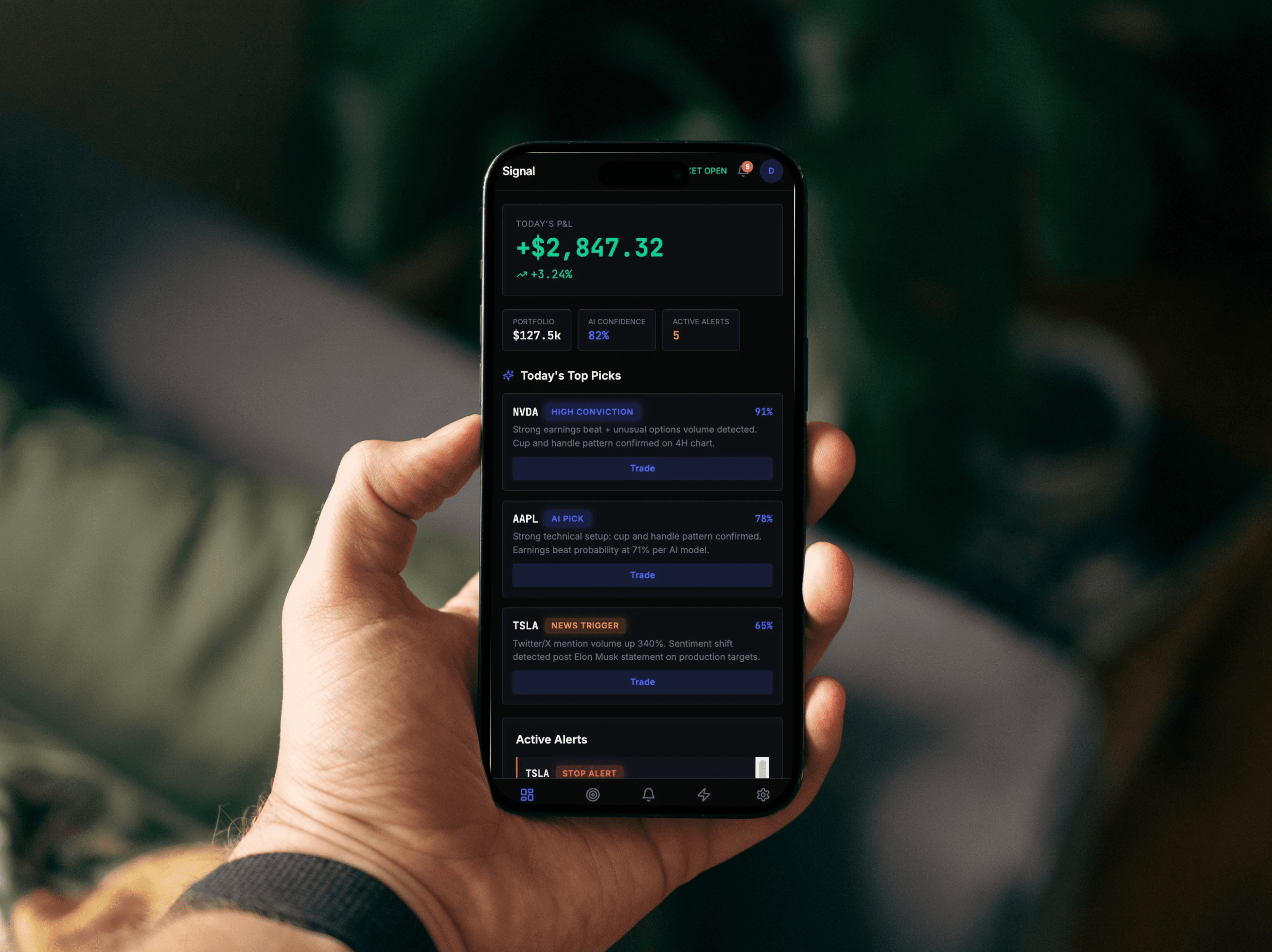
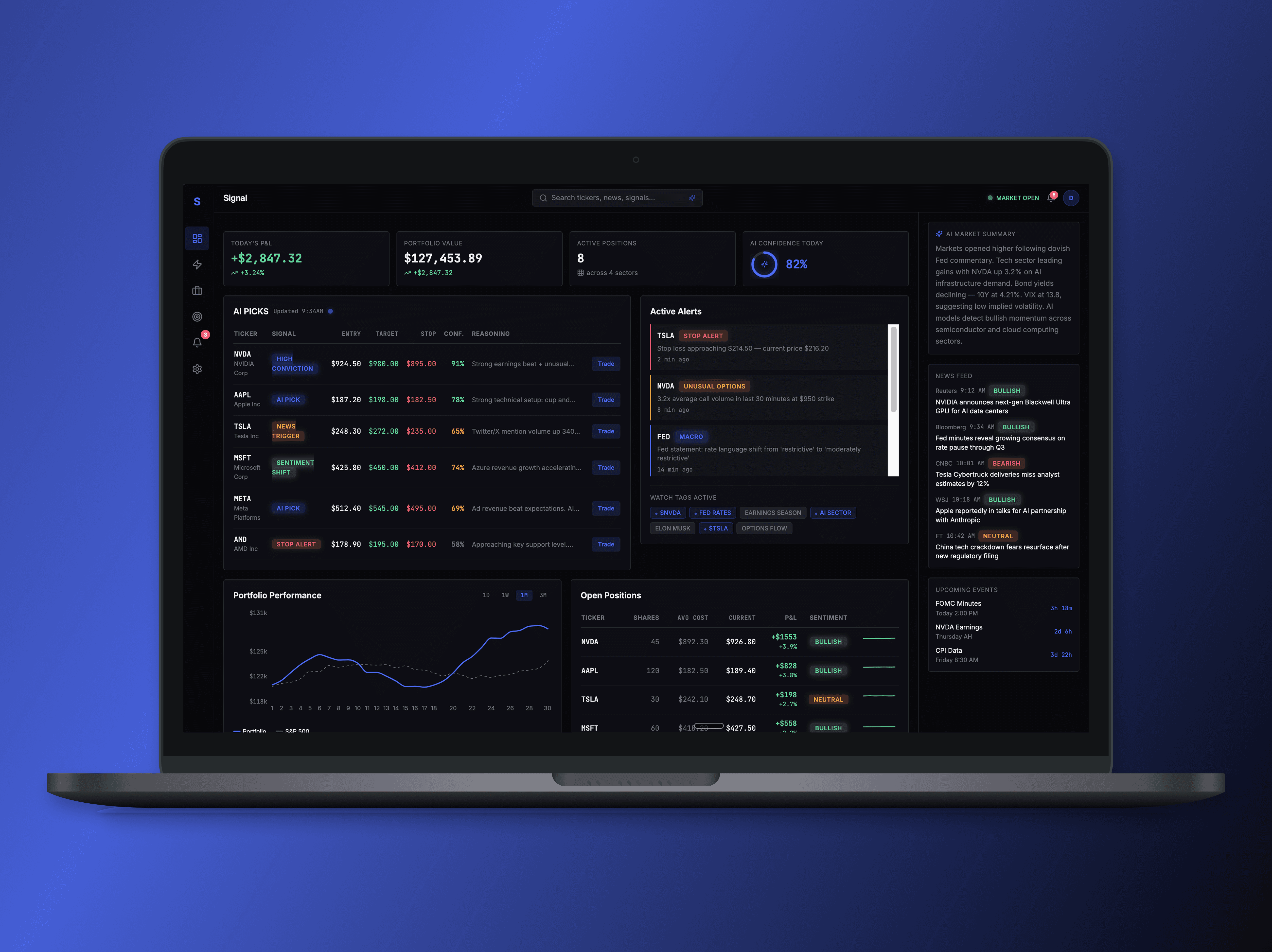
Note: The original deliverables from this engagement are confidential and cannot be shared publicly. The screens shown here are reconstructed mocks created to illustrate the product direction and design decisions, not reproductions of the final client work.
—— CHALLENGE
These founders were experienced investors who understood markets but had no shared product vision, no UX, and investors watching closely. The real design challenge wasn't building screens. It was earning trust: making a complex, multi-signal AI feel transparent enough to act on, simple enough to check from a phone mid-round of golf, and safe enough to run with real money.
—— solution
The core insight from research: the founders didn't want to manage a product. They wanted to trust a system. Every design decision was in service of one goal: make the AI invisible when things are going well, and immediate when they're not.
Hands-off automated trading
An AI engine that runs continuously in the background, analyzing signals, generating picks, and executing trades automatically with no manual intervention required. The system handles the work. The founders handle their lives.
Proactive SMS alerts
Automatic text alerts sent directly to the founders' cell phones when the system needed their attention: an urgent signal, a triggered stop loss, a high-conviction opportunity. No app to open, no dashboard to check. Just a text when it matters.
Personalized AI intelligence
Every pick came with a plain-language breakdown of why the system made the call: fundamentals, technicals, sentiment. Once set up, the system also learned each investor's preferences, risk tolerance, and areas of focus, filtering recommendations through the lens of what mattered to that specific investor. Rather than a one-size-fits-all signal feed, the AI tracked market changes relevant to their portfolio and watchlist, surfacing only what was personally significant rather than flooding them with noise.
—— 4 key design decisions
—— PROCESS
WEEKS 1–2
Stakeholder discovery
Worked directly with the founders to understand their trading philosophy, daily workflows, and what "hands-off" actually meant to them in practice. Identified the highest-impact design opportunities.
WEEKS 2–3
Domain immersion and strategy
Went deep on trading fundamentals, studying signals, metrics, and what actually moves investors, to build enough fluency to have intelligent conversations with domain experts and make defensible design decisions.
WEEKS 3–5
UX design and flows
Designed the full product experience across dashboard, picks, alerts, performance tracking, risk controls, and automated trading settings.
WEEKS 5–12
Prototyping, testing and PoC
Iterated on designs alongside development, tested explainability flows with stakeholders, and refined the alert logic until the system felt trustworthy enough to run with real money.
The Override
—— DELIVERABLES
Working Retool proof of concept refined with development team, 32-opportunity AI landscape map with scoring framework, top 10 and top 3 opportunity decks for stakeholder presentation, 12-month AI implementation roadmap, weekly stakeholder alignment documentation throughout the engagement.

AI-powered day trading
DENVER —— CO